|
PDF of this file Fact
sheet for Australian toy importers and traders
A fact sheet for Australian toy importers and traders
By Ellie Li and Elizabeth O’Brien, Global Lead Advice
& Support Service (GLASS), Australia, written for the Toy Fair,
Melbourne 21st & 22nd March 2009; updated by Martin Bagnall 1st April
2011
-
I don’t want to poison Aussie kids with heavy
metals in toys” AGREE
DISAGREE
-
I don’t want to pay a million dollar fine if ACCC
happens to buy my toys off the shelf in 2010 and they fail the toy tox tests
at NMI” AGREE
DISAGREE
|
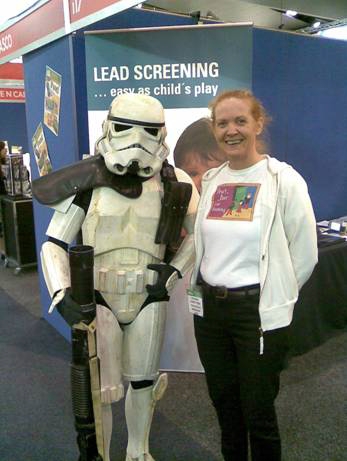
Photo by Michael Nayda, Thermo Scientific.
|
If you AGREE with both the above statements,
then this factsheet is for you! It was created for distribution by
Elizabeth O’Brien (pictured wearing “Shut the Door on Lead
Poisoning” t-shirt, alongside Star Wars Stormtrooper) stand on
Saturday 21st and Sunday 22nd March 2009, at the Australian Toy
Hobby and Nursery Fair in Melbourne, run by the Australian Toy
Association (ATA).
The ATA’s Exhibitor Bulletin, Day 3 -
Sunday 22nd March 2009, noted:
“Yesterday you would have received an ACCC
Product safety bulletin [March 2009]. One of the articles therein
referred to lead in children’s toys and the new mandatory standard
effective from 1 January 2010.
“Today international lead expert Elizabeth
O’Brien of The LEAD Group will be at the Thermo Scientific stand
(i17) to answer all your queries about lead. A free toy ‘tox’
screen will also be available.” |
WHAT TO DO IF YOUR TOYS FAIL THE XRF TEST
How can I be sure about the concentration of leachable heavy metals in
my toys?
XRF
technology is a rapid and convenient tool that enables instant detection of
all the 8 heavy metals in the Australian Toy Standard AS/NZS ISO
8124.3:2003, allowing many toys to be tested compared to the time and cost
that a lab would take to test toys.
Savings are
significant in both time and money, as XRF identifies only those toys that
need be referred to the lab for tox tests.
XRF
identifies the “total amount” of presence of heavy metals in a toy
sample, which is not the same as the leachable, or migratory properties of a
heavy metal.
For example;
if a toy, or toy component, screened using XRF is identified as high in
“total amount” of a heavy metal(s), then you will need to send it to a
qualified laboratory for the toy tox test for that particular heavy metal.
This will determine exactly how much of the metal leaches(migratory
properties) from the toy and whether it exceeds the Australian Toy Standard.
In other
words, a toy can fail the XRF test but pass the lab test, so confirmatory
lab testing is essential on those toys/parts that fail the XRF test.
XRF
technology is widely used and accepted by Australian state and federal
government regulators, as a means of rapid screening for the identification
of the presence of heavy metals in toys.
Once a toy
has been identified by XRF technology as high in a heavy metal and in order
to fully comply with Australian standards, ACCC (Australian Competition and
Consumer Commission) stipulates that toy testing can be done at any suitably
qualified laboratory. This can be either through a lab that is NATA
(National Association of Testing Authorities)-accredited for the particular
test, or a lab that is NATA-accredited for related tests and which offers
toy testing according to the toy standard methodology. The following is a
list of relevant lab contacts for your information.
If your toys are in Australia, XRF testing services are conducted by;
 Sampling Technologies Pty Ltd
www.sampletech.com.au
Contact: Mr Martin Bagnall
PH: 1800 453 394
FX: 03 8668 1303
Email: info@sampletech.com.au
PO Box 1178, Kensington,
Victoria,
3031
Sampling
Technologies service is a portable service, providing testing on site with
trained staff and XRF equipment at any facility around Australia and New
Zealand.
For toy tox test labs in Australia, visit www.nata.asn.au
- eg:
1. National Measurement Institute (NMI)
www.measurement.gov.au
Contact: Ms
Emma Tiberi
Phone: (03)
9644 4888, Fax:(03) 9644 4999
Mobile: 0413 947 990
1/153 Bertie Street
PORT
MELBOURNE VIC 3207
Facilities:
Public testing service ACCREDITED by NATA for Analysis of toys
Analysis
by ICP-
AES
techniques by the methods of - AS/NZS ISO 8124.3 for the following
determinations - soluble elements: Antimony; arsenic; barium; cadmium;
chromium; lead; mercury; selenium.
2. Sydney West Area Health Service
DAL Public Health
Contact: Mr
R Angulo
Phone:(02)
9646 0222
Division of
Analytical Laboratories
Joseph Street and
Weeroona Road
LIDCOMBE NSW
2141
Facilities:
Conditionally available for public testing
ACCREDITED
by NATA for Analysis of paint from children's toys and from buildings;
Analysis by AAS
(flame) techniques by in-house method TM118B; for Lead.
3. Sydney Analytical Laboratories Pty Ltd,
Watertest
Contact:
Mr L Smith
Phone:(02)
9838 8903
Sydney
Chemical Testing Laboratory
1/4
Abbott Road
SEVEN HILLS NSW 2147
Facilities: Public
testing service
ACCREDITED
by NATA for Paints and related
surface coatings; Chemical tests: Analysis of paint scrapings; Analysis by
AAS
techniques by in-house method A8; for Lead.
If your toys are still at the factory overseas,
you can organise testing in one of the SGS labs overseas, accredited
for the toy tox test, by contacting:
Nathan
Temple
SGS Australia Pty
Ltd
480 Princes Highway, Noble Park, VIC 3174, Australia
Phone:
(03) 9790-3479. Fax: (03) 9701-0988
Mobile:
0410-505-381
Email:
nathan.temple@sgs.com
Website: www.au.sgs.com/
Eg,
CNAS’s (China National Accreditation Service for Conformity Assessment)
Directory of Accredited Laboratories at http://219.238.178.49/AccSearchEN.asp?Class=L
lists:
SGS-CSTC
Standards Technical Services Co., Ltd. Shenzhen Branch Toys Lab, Futian
District, Shenzhen, Guangdong, China; ACCREDITED by CNAS for AS/NZS
ISO8124.3:2003; ISO8124-3: 1997; GB 6675-2003 clause 4.3 - Safety of toys -
Migration of certain elements.
See
“Product safety bulletin October 2007: Banned lead in children's toys”
at http://www.accc.gov.au/content/index.phtml/itemId/800643
regarding the current ban.
Look out for the suppliers’ guide published on the ACCC website prior
to the start of the mandatory toy standard in January 2010. See http://www.accc.gov.au/
Don’t put off testing your toys any longer!!
Ask about
The LEAD Group’s charity rates for bulk toy testing through Sydney
Analytical Laboratories or by XRF, using Sampling Technologies (www.sampletech.com.au
). We also have our DIY-sampling lead safe test kits available for sale to
parents, day care centre managers, retailers, etc, who wish to test the
concentration of lead and other heavy metals around their house/ centre/
/workplace and within their toys. See
Do
It Yourself Lead Safe Test Kits Ad.html
For large
batches of toys, The LEAD Group would refer you for XRF testing by Sampling
Technologies (see above).
|