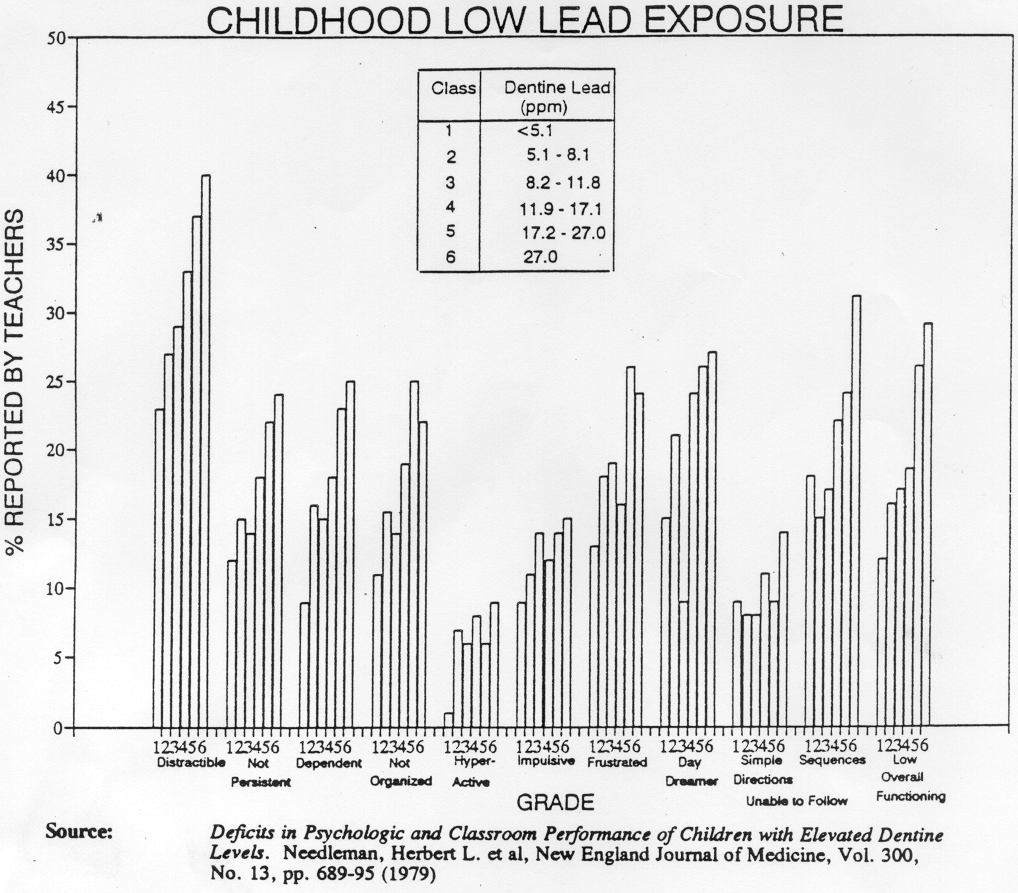
Lead Poisoning And The Brain - Cognitive Deficits And Mental Illness By Michelle Naylor - Behavioural Health Sciences, Sydney University Over the past few decades, research on the neurotoxic effects of lead has predominantly focused on cognitive deficits in children and infants. Evidence demonstrating various learning and behavioural problems resulting from lead exposure is voluminous, and links have been discovered between lead-poisoned children and deficits in a variety of functions. Some problems observed in the classroom by Anne Winner (1994) that have been associated with lead poisoning include a mild decrease in IQ, slower response time, central auditory processing problems, word finding difficulties, sequencing difficulties, and perceptual integration problems. Even at low BPb levels, lead exposure has been associated with deficits in the early developmental years. Canfield et al.’s study (2003) on the effects of low level lead poisoning (< 10 µg/dL) on cognitive functioning in children and infants, found that IQ declined 7.4 points as average blood lead concentrations increased from 1 µg/dL to 10 µg/dL, and then declined 4.6 points for every 10 µg/dL increase after that. These studies and others have provided strong support for the role of Pb as a neurotoxin in children and infants. So how do developmental disturbances caused by exposure to lead manifest later in life? Young children and infants are the most vulnerable to the effects of lead poisoning. It can, however, have a detrimental effect on the cognitive abilities of adults as well. A case study on adult monozygotic twins with lead poisoning, both who were retired painters, had typical patterns of cognitive difficulties following chronic lead exposure. This pattern included predominant impairments in the domains of attention/executive function, visuospatial/visual motor functioning, short-term memory, and (for one of the brothers) confusion and fatigue. After exposure to toxicants such as lead in adulthood, cognitive deficits tend to be specific, not generalized, and not affecting language centres in the brain (Weisskopf et al., 2004). Lead exposure has also been linked to behavioural problems. In his landmark study, Needleman (1979) measured dentine Pb levels in 312 first-and second-grade students (mean age 7.3 years), and administered neurobehavioural tests. The results showed that behavioural and performance problems in primary school children were more prevalent with increasing dentine (teeth) lead levels. These behavioural problems included hyperactivity, distractibility, impulsivity, disorganisation, non-persistence, inability to follow simple instructions and overall poor functioning.
When the subjects were re-examined in 1988 (mean age 18.4 years), results showed that increased dentine Pb levels were associated with an increased risk of not graduating from high school, reading difficulties significant enough to be defined a disability, lower class standing in high school, increased absenteeism, lower vocabulary and grammatical-reasoning scores, increased reaction times, and slower finger tapping (Needleman, 1990). Lead levels were also inversely related to self-reports of minor delinquent activity. It was concluded on the basis of these results that exposure to lead in childhood is associated with deficits in neurobehavioural functioning later in life. These and other studies such as those by Needleman (2002), in which elevated body bone lead concentrations were found to be associated with elevated risk for adjudicated delinquency, and Dietrich et al (2001), support the relationship between lead exposure and juvenile delinquency. Given these findings, and the results of studies such as those by Serene Olin and Mednick (1996) in which people with schizophrenia were more likely to have had behavioural problems before the onset of the disorder then the general population, it was only a matter of time before the effects of lead poisoning on psychological function were to be investigated. The results from this study are consistent with the neurodevelopmental hypothesis of schizophrenia, which posits that the illness is related to abnormal brain development (Nopoulos et al, 1995; Marenco & Weinberger, 2000). At a conference in early 2004, research findings were presented on a study that examined the relationship between lead exposure during the second trimester of pregnancy and schizophrenia. The longitudinal study involved 20 000 people who were born between 1959 and 1967. The mothers were identified at their first prenatal visit, and blood samples were taken at every prenatal visit. The man who initiated the study, Jacob Yerushalmi had since died, and Opler et al. (2004) followed up the schizophrenia outcomes. Potential cases of schizophrenia spectrum disorder from Yerushalmi’s study were identified using computerized records from inpatient, outpatient, and pharmacy databases. After standardized procedures involved in making or confirming diagnoses were carried out, forty-four of the seventy one cases established as having a schizophrenia spectrum disorder had second trimester maternal serum samples available for analysis. Because only serum samples, and, not whole blood specimens were available for analysis, an indirect biologic marker of lead exposure, d -aminolevulinic acid (d -ALA), was used to determine blood lead levels. Mid-pregnancy serum samples were sought for this analysis, because, unlike in the very early and very late stages of pregnancy, much more is known about the behaviour of d -ALA in the mid-pregnancy period. The results indicated that during mid-gestation, if levels of d -ALA are high (=15 µg/dL), the chance of having schizophrenia later in life is doubled. On the basis of these results, the authors have suggested that more study is required to further establish, and to investigate possible biological mechanisms involved in the relationship between elevated blood lead levels during the second trimester of pregnancy and the development of schizophrenia. The damage that lead poisoning can have on the neuropsychological functioning of the central nervous system can be devastating. It can affect anybody, at any age, although children are most often the worst affected, as their cognitive development can be disrupted. Now we are beginning to realize that there are consequences beyond what was once thought the neurological endpoint for this harmful substance, and hopefully we will one day fully understand the mechanisms by which lead destroys the mind. REFERENCES
|
||||||||||||||||||||
The LEAD Group Inc. Fact Sheet Index |
||||||||||||||||||||
|
NSW
Lead Reference Centre and NSW Government Publications On this site
|
||||||||||||||||||||
|
About
Us |
bell
system lead poisoning |
Contact Us
| Council
LEAD Project | egroups | Library
- Fact Sheets | Home
Page | |
||||||||||||||||||||
|
Visitor
Number
Last
Updated 01 May 2014
|
||||||||||||||||||||