LEAD
Action News vol 10 no 2, June 2010, ISSN 1324-6011
Incorporating Lead Aware Times ( ISSN 1440-4966) and Lead Advisory Service
News (ISSN 1440-0561)
The Journal of The LEAD (Lead Education and Abatement Design) Group Inc.
Vitamin D:
(calciferol) has a mixed reputation: it increases the uptake of lead,
calcium and iron. In different studies it is associated with both higher
and lower lead levels. It may increase blood lead levels when dietary
calcium and iron intake is inadequate. It is possible to speculate that
good levels of vitamin D may reduce lead deposition in the bones if
calcium, magnesium and phosphorus nutrition is adequate, but may release
lead from bone if calcium, magnesium and phosphorus intake is inadequate
due to increased bone resorption (the recycling of calcium and other
minerals including lead from the bone to the bloodstream). Vitamin D is
essential to the effective utilization of calcium for bone formation and
significant deficiency can negate or even reverse some of the advantages
of calcium supplementation. It also increases magnesium and phosphorus
absorption but unfortunately calcium competes with phosphorus for
absorption. Solid Vitamin D levels may help protect against H. pylori
infections that reduce stomach acidity, in turn reducing iron, zinc,
copper, calcium and vitamin B12 absorption.
Distortion of the
vitamin D metabolism is one effect of lead toxicity, reducing the amount
transformed into the form most useful to the human body
(1,25-dihydroxycholecalciferol [(1,25(OH)2D)] ), though at moderate lead
levels (less than 20 µg/Dl), this appears to have major impacts only when
other nutrient intakes, notably calcium, are inadequate. Vitamin D is
produced in the body from exposure to sunlight, but individuals who get
insufficient sun exposure, always wear sunscreen when outdoors, or are
dark skinned and living in temperate/boreal zones may need to obtain
significant vitamin D from their diet. In the USA most milk, though not
milk products (eg. cheese, yogurt), are fortified with vitamin D, and
fortified dairy products are available in other countries. The primary
source of vitamin D in unfortified food is fish, with wild fish tending to
have higher levels of vitamin D and omega 3 than farmed fish, due to
differing food consumption. Egg yolks and livers also contain smaller
amounts of vitamin D, while for vegans mushrooms grown under ultraviolet
light contain vitamin D levels similar to fish though this product has yet
to become widely available. High
levels of vitamin D supplementation can increase calcium deposition in
soft tissues (hypercalcaemia) leading to renal and heart problems, so
supplementation at more than 0.025 mg (I,000 IU) a day should only be
undertaken with medical supervision, according to the UK Expert Group on
Vitamins and Minerals. The risk of renal (kidney) stones may increase for
some individuals at lower dosages (from around 400 IU), but on the whole
vitamin D supplementation appears to lower risks of mortality.
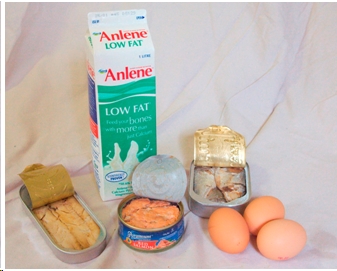
Vitamin D: There
are few good food sources of vitamin D. Some food sources such as
some milk types have vitamin D added (rear picture) but the
primary unfortified source is fish (centre row: haddock, salmon
and sardines) though similar quantities are available from
mushrooms grown under ultraviolet light (not yet widely
available). Much smaller quantities are available from egg yokes
(front right) and liver
Sunlight and vitamin D
for bone health and prevention of autoimmune diseases, cancers, and
cardiovascular disease Michael F Horlick American Journal of Clinical
Nutrition, Vol. 80, No. 6, 1678S-1688S, December 2004 http://ajcn.nutrition.org/content/80/6/1678S.full.pdf+html
[outlines the role of sunlight in generating vitamin D and the food
sources for vitamin D]
Relation
of Nutrition to Bone Lead and Blood Lead Levels in Middle-aged to Elderly
Men: The Normative Aging Study Yawen Cheng, Walter C. Willett, Joel
Schwartz, David Sparrow, Scott Weiss, and Howard H American Journal of
Epidemiology Vol. 147, No. 12 http://aje.oxfordjournals.org/content/147/12/1162.abstract
[Finds that low Vitamin D is associated with higher bone lead levels and
has more of an impact than calcium intake.]
Maternal Blood Lead
Concentration, Diet During Pregnancy, and Anthropometry Predict Neonatal
Blood Lead in a Socioeconomically Disadvantaged Population Lawrence M.
Schell, Melinda Denham, Alice D. Stark,
Marta Gomez, Julia Ravenscroft, Patrick J. Parsons, Aida Aydermir,
and Renee Samelson Environmental Health Perspectives Volume 111, Number 2,
Feb 2003 http://www.ncbi.nlm.nih.gov/pmc/articles/PMC1241350/pdf/ehp0111-000195.pdf
[Finds that calcium is a slightly better predictor of blood lead but
broadly agrees with the previous study. It must be noted that both studies
are from the US where milk is routinely supplemented with vitamin D so a
close relationship with calcium would be expected.]
Effects of
Micronutrients on Metal Toxicity Marjorie A. Peraza, Felix Ayala-Fierro,
David S. Barber, Elizabeth Casarez, and Leonard T. Rael Environ Health
Perspect 106(Suppl 1):203-216 (Feb 1998). http://www.ncbi.nlm.nih.gov/pmc/articles/PMC1533267/pdf/envhper00536-0213.pdf
[Has a good, one paragraph summary of research on vitamin D and lead
absorption on page 207 column 1]
Elevated Blood Lead
Concentrations and Vitamin D Deficiency in Winter and Summer in Young
Urban Children Kemp, Francis A; Netti, P; Howell, RW; Wenger, P; Louria;
Bogden JD Environ Health Perspect Vol 115 No4, April 2007 http://www.ncbi.nlm.nih.gov/pmc/articles/PMC1852643/pdf/ehp0115-000630.pdf
[Finds that vitamin D levels possibly contribute to seasonal variations in
children’s blood lead levels with higher vitamin D levels associated
with higher blood lead levels]
Serum Vitamin D
Metabolites and Bone Mineralization in Young Children With Chronic Low to
Moderate Lead Exposure Winston W.K. Koo, Susan K. Krug-Wispe, Jean J.
Steinchen, Reginald C. Tsang, Paul A. Succop, Robert L. Bornschein, Omer
G. Berger Pediatrics Vol. 87 No. 5 May 1991, pp. 680-687 http://pediatrics.aappublications.org/content/87/5/680.abstract
[Found that at blood lead levels below 20 µg/Dl lead did not have
significant effects on 1,25-dihydroxycholecalciferol levels if levels of
calcium, phosphorus and Vitamin D were adequate]
Vitamin D
Supplementation and Total Mortality Philippe Autier; Sara Gandini Arch
Intern Med. 2007;167(16):1730-1737 http://archinte.jamanetwork.com/article.aspx?articleid=413032
[finds that vitamin D
supplementation, unlike most antioxidant supplementation, tends to reduce
mortality rates]