|
|
||||
|
LEAD Action News Vol 3 no 2 Autumn 1995 ISSN 1324-6011 |
||||
|
About Us
|
The Environmental Cost of the Car
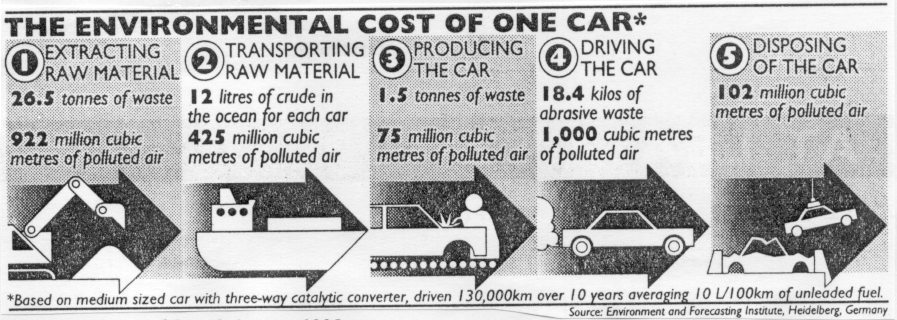
by John Whitelegg This article appeared on page 10 of the Sydney Morning Herald on Tuesday, August 3rd 1993. Reproduced with kind permission The private car is an environmental, fiscal and social disaster which would not pass any value-for-money test according to a German report. Researchers at the respected Environment and Forecasting Institute in Heidelberg take a medium-sized car and assume it is driven for 13,000 kilometres a year for 10 years to compute its financial, environmental and health impacts "from cradle to grave". Long before the car has got to the showroom, they find it has produced significant amounts of damage to air, water and land ecosystems through the extraction of raw materials alone. We're not even on the road yet and this me car has produced 26.5 tonnes of waste and 922 cubic metes of polluted air. In 10 years, this one car (with a three-way catalytic converter and using 10 litres of unleaded petrol for every 100 kilometres) will produce 44.3 tonnes of carbon dioxide, 4.8 kilograms of sulphur dioxide, 46.8 kg of nitrogen dioxide, 325 kg of carbon monoxide and 36 kg of hydrocarbons. It will pump another 1,000-odd cubic metres of polluted air into the atmosphere and will strew the roadside with 1 8 kilograms of worn bits of road surface and tyre and brake debris. The environmental impact continues beyond the end of the car's useful life. Disposal of the vehicle produces a further 102 million cubic metres of polluted air and quantities of PCB's and hydrocarbons.
While this detail is impressive (and wholly absent from the environmental claims of motor vehicle manufacturers and motoring organisations), it is still not complete. Some of the more startling revelations are in the researchers' wider analysis of social and environmental costs. Germany suffers from extensive forest damage attributed to acid ain and vehicle exhaust emissions. The researchers calculate that each car in its lifetime is responsible for three dead trees and 30 "sick" trees. They illustrate the German accidents: each car, they experience with road traffic say, over its lifetime is responsible for 820 hours of 'life lost through a road traffic accident fatality and 2,800 hours of life damaged by a road traffic accident. Statistically, they suggest one person in every 100 will be killed in a road traffic accident and two out of every three injured. Land-use data are also brought into the equation to show that Germany's cars, if one includes driving and parking requirements, commandeer 3,700 square kilometres of land - 60 per cent more than is allocated to housing. Every German car is responsible for 200 square metres of tarmac and concrete. The total impact of the car over all the stages of its life cycle also produces a quantifiable financial cost. The Heidelberg researchers estimate this to be 6,000 Deutchesmarks (about $A5,220) a year per car, covering the external costs of all forms of pollution, accidents and noise after income from all sources of vehicle and fuel taxation are taken into account. This is a State subsidy equivalent to giving each car user a free pass for the whole year for all public transport, a new bike every five years and 15,000 kilometres of first-class rail travel. |
|||
|
About
Us |
bell
system lead poisoning |
Contact Us
| Council
LEAD Project | egroups | Library
- Fact Sheets | Home
Page | Newsletters | Q & A | Referral lists | Reports | Site Map | Slide Shows - Films | Subscription | Useful Links | Search this Site |
||||
|
Last
Updated 15 November 2012
|
||||