|
|
||||
|
LEAD Action News
Vol
3 no 1 Summer 1995.
ISSN 1324-6011 |
||||
|
About Us
|
NSW Elections '95: Making the Most of your Vote on 25/3 by
Anne Roberts, Total Environment Centre What the elections are
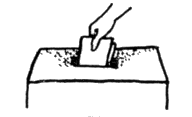
about. When you go to vote on March 25, your name will be checked off, and you will be given three ballot papers to fill in. One will be for the election for the Legislative Assembly, a second for the election for the Legislative Council, and a third for referendum questions. Legislative Assembly You are voting for the person who will represent your electorate in the 99-seat Legislative Assembly. The Legislative Assembly is the main law-making body of the State Parliament. Whichever political party wins a majority of electorates forms the Government, and runs the State until the next election. Legislative Council Your vote goes towards electing 21 Legislative Councillors - half the number of seats in the Legislative Council. The Legislative Council and the Legislative Assembly are the two "Houses" that make up Parliament. The Party which holds Government (that is, which has a majority in the Assembly) does not necessarily have to have a majority in the Council. Referenda You are voting on matters not provided for under the NSW Constitution, and which therefore require a referendum, to change the Constitution. Legislative Assembly: Making the most of your vote (1) Fill in the ballot paper correctly, otherwise you risk having your vote declared "informal"; in which case, it is not counted as a vote for any candidate. Write the number "1" in the box next to the name of your most preferred candidate. Your number "1" vote is your "primary", or "first preference" vote. Write "2" in the box next to the name of your next preferred candidate, and so on. (Hence the word "preferences", to describe how voters have numbered the candidates.) Do not use ticks or crosses. Print the numbers carefully, fully inside the boxes. Do not scribble anything which could identify whose vote it is. (Votes are required to be anonymous.) (2) Don't just vote "1" for your most preferred candidate, and leave the other boxes blank. Otherwise, if your candidate is eliminated ("excluded") because they are the one with the least number of votes at any stage of the count, your vote is "exhausted", and cannot go on to help elect anyone. (Major Parties try to frighten voters by telling them a vote for an Independent, or minor Party, is "wasted" - it isn't, provided you indicate further preferences.) (3) Use the opportunity to convey a message to major Parties: You can be a major party voter, but think some of the issues Independents or minor parties have raised are important, and want the major parties to know this. The best way is to give your FIRST preference to the Independent or minor party candidate, and your SECOND preference to the major party candidate of your choice. If you put the major party first, and minor parties second, and the major party candidate wins or is runner up, there is no record of your having shown support for the minor party. (The Electoral Office keeps a record of how preferences were allocated on the ballot papers of all other candidates in each electorate. Or you can give your primary vote to an Independent, or member of a minor party, because you want them to win. Legislative assembly: How votes are counted To win, a candidate has to get 50% of the votes, plus one vote. The first round of counting is to count the number of ballot papers marked "1". If there are only two candidates, one of them will win on the first round. If there are more than 2 candidates, it may happen that no-one gets 50% plus one, of the primary votes. The candidate with the fewest primary votes is excluded. Preferences are distributed, which means, each ballot paper of the excluded candidate is given, as a full vote, to the candidate marked as the next preference, on the ballot paper. (Thus, if a candidate is excluded after Round one, this candidate's ballot papers are handed on to whoever is marked "2".) Ballot papers which do not show continuing preferences are exhausted, and thus there are fewer votes in the count. The process of excluding candidates continues, until one candidate has 50% plus one, of the votes remaining in the count. Legislative Council: making the most of your vote The ballot paper for the Legislative Council has candidates' names grouped in columns. For each political party or group, there will be a single box above the columns of names, separated by a horizontal line. There are two ways to fill in the ballot paper correctly: * "Ticket" vote: Write the number "1" in the box above the line, next to the name of the party or group you prefer. Your vote will go towards helping elect candidates on the party "ticket". Do not use ticks or crosses. Do not fill in any other boxes, either above or below the line. * "Below the line" Write consecutive numbers, starting with "1", in the boxes alongside the names of the candidates, below the line. You can write the numbers in any order, but you must number at least 15 names, and may number them all. Use numbers, not ticks or crosses. Do not fill in any boxes ABOVE the line. It is difficult to make the most of a below-the-line Legislative Council vote unless you thoroughly understand how the votes are counted. This is complicated, and defies brief description. It is easier to cast a ticket vote, and most people do. A poster displayed in the polling station will show how Parties have allocated preferences. Legislative council: How votes are counted To be elected, a candidate must achieve a quota, that is, a certain proportion of the total formal vote for the whole State. (A formal vote is one where the ballot paper has been correctly filled in.) In the coming election, a candidate will have to get 4.54% of the total formal vote. (About 165,000 votes.) Surplus votes are passed on, to the next candidate on a Party "ticket" or on a "below the line" vote. Eventually, there may not be enough surplus votes to elect any more candidates, yet there may be two or three candidates still to be elected. What happens then is that the candidates with the least number of votes are excluded, in turn. Whoever is marked as next preference (whether on your ticket, or below-the-line vote) on each excluded candidate's ballot papers gets the vote given to them. If the candidate shown as next preference is already elected or excluded, the vote goes on to the next preferred candidate on the ballot paper, until all 21 candidates are elected. Referenda There will be two questions, requiring a "yes" or "no" answer. Put a TICK in the "yes" box if you agree, or in the "no" box if you disagree |
|||
|
About
Us |
bell
system lead poisoning |
Contact Us
| Council
LEAD Project | egroups | Library
- Fact Sheets | Home
Page | Media Releases Newsletters | Q & A | Referral lists | Reports | Site Map | Slide Shows - Films | Subscription | Useful Links | Search this Site |
||||
|
Last
Updated 14 November 2012
|
||||