|
|
||||||
|
LEAD Action News
Vol
3 no 1 Summer 1995.
ISSN 1324-6011 |
||||||
|
About Us
|
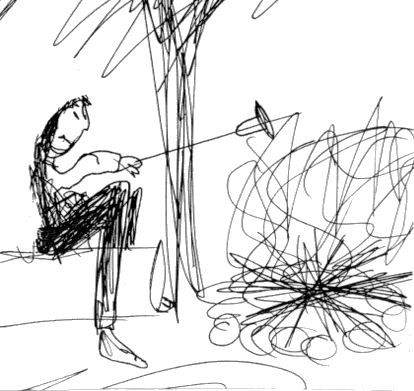
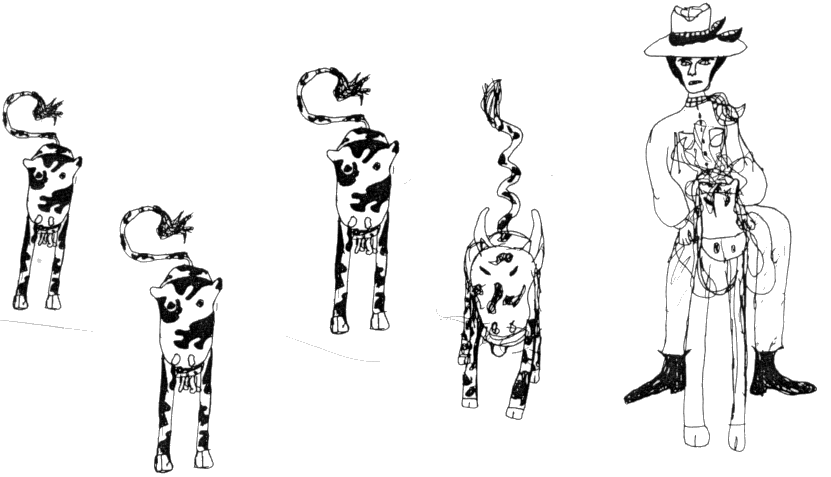
Lead in Literature "Lonesome Shorty" by Garrison Keillor Lonesome Shorty is one of the excellent short stories from "The Book of Guys", a best-seller by Garrison Keillor, first published in 1993 by Viking Penguin, a division of Penguin Books USA Inc. First published in Great Britain in 1994 by Faber and Faber Ltd, London. Reprinted with kind permission of Faber and Faber publishers and the author. Apart from all the "hot lead [bullets] flying", look out for the hidden "lead" references:- the use of the word "plumb" as in the terms "plumb out of" and "plumb loco" from the Latin "plumbum" meaning lead and the Spanish "loco" meaning crazy in US slang. The second meaning of "loco" according to the Australian Pocket Oxford Dictionary is a poisonous leguminous plant. In the US, cattle eating loco are affected by a brain disease (loco disease) and in Australia, loco disease is a similar brain disease affecting stock eating Darling Pea. "Plumb loco" could therefore be freely interchanged with the term "plumb crazy" in your conversations. [A vocabulary-building tip from your editor!] The summer before last, I was headed for Billings on my horse Old Dan, driving two hundred head of the ripest-smelling longhorns you ever rode downwind of, when suddenly here come some tumbleweeds tumbling along with a newspaper stuck inside - I had been without news for weeks so I leaned down and snatched it up and read it trotting along, though the front page was missing and all there was columnists and the Lifestyle section, so bouncing along in a cloud of manure I read and article entitled "43 Fabulous Salads too Freshen Up Your Summertime Table" which made me wonder if my extreme lonesomeness might not be the result of diet. Maybe I'm plumb loco, but a cowboy doesn't get much fiber and he eats way too much beef. You herd the cattle all day, you come to despise them, and pretty soon, by jingo, you have gone and shot one, and then you must eat it, whilst all those cattle tromping around on the greens takes away your taste for salads, just like when you arrive at a creek and see that cattle have tromped in the water and drunk from it and crapped in it, it seems to turn a man toward whiskey. I thought to myself, Shorty, you've got to get out of this cowboy life. I mentioned this to my partner, old Eugene, and he squinted at me and said, "Eeyup." "Eugene," I said, "I've been cowboyin' for nigh onto two decades now. I know every water hole between Kansas and the Sierra Nevada, but consarn it, I miss the company of my fellow man. Scenery ain't enough for me, Eugene, nor freedom. I'm sceneried out, pardner, and freedom is vastly overrated as an experience, if you ask me. I got to be with people. I'm a people cowboy, not a cow cowboy." A few miles of purple sagebrush drifted by and a hawk circled high in the sky. "Do you hear what I'm sayin? I inquired. He said, "Eeyessir." I said, "Give me a home where the buffalo roam? It don't follow, Eugene. Buffalo have nothing to do with home, nothing at all. And I'm sick o'deer and antelope, Eugene. I'm sorry if this sounds like a discouraging word, but animals do not make for a home, Eugene. Not on the range nor anywhere else." I continued, "And whoever wrote The air is so pure and the breezes so free, the zephyrs so balmy and light never spent time driving cattle, I can tell you that." He grunted. A few miles later, I said, "You ever think of just calling yourself Gene, Eugene? Gene is more of a cowboy name. Eugene is sort of a bookkeeper's name. How about I call you Gene, Gene?" He thought this over for a few miles as we jangled along, eating dust. Then he said, "You do that and I'll lay for you and jump you and gouge your eyes out and bite off your ear." "You'd rather be Eugene, then?" "Eeyup." We rode along for a ways. "Is there some topic you have a desire to talk about, Eugene?" I inquired. "Nope." A taciturn sidekick is like buying a ticket to see the sun set. Who needs it? You go humping along the trail, you would like some conversation, but no, Eugene could no more think up things to say than he could sing La Traviata. That night, I was feeling low. The wood was wet and the campfire smoked, the beans were cold and the pork half raw, the mosquitoes descended in a cloud, and then it took hours to get the cattle bedded down, and as I was fetching a camp stool from the saddlebags, Old Dan accidentally stepped on my foot and about broke it. I hopped around on the good one and swore a blue streak, but none of it woke Eugene. He was wrapped in his blankets, dead to the world. I sat down and listened to Dusty Joe on night watch, slowly circling the herd and singing `Tenting Tonight on the Old Campground,' but all he knew was the chorus, and he sang that over and over. I approached him where he sat on his horse on a little rise and asked him if he could not vary his performance. "The cows like it." he said. "That may be so," I replied, but you are drivin' me crazy. Why'n blazes can't you sing something else? Sing `Bury Me Not on the Lone Prairie' for Pete's sake of `The Night Herding Song'. Lay off the tenting tonight - it ain't even a cowboy song, for cryin' out loud." He said it was the only song he knew. I remarked that it was a poor cowboy indeed who couldn't make up some songs of his own. "Just sing I ride an old paint, I lead an old Dan, I'm goin' to Montana to throw the hoolihan, and then keep making up new verses." But of course he was stubborn and wouldn't do it. I got back to camp and I hear the damn tent song start up again, and of course the wind carried it right back to us. To distract myself, I sat down and drew up a list of pros and cons on the back of a picture of my mother. Reasons to Be or Not to Be a Cowboy Freedom to be your own man. The awful loneliness of doing so.
Good old Dan - What else can he do but ride the trail? You can't live for your horse, especially not one who steps on you.
The chance to be a True Cowboy, who stands up for what's Right and Fair. Fine, but it's time to settle down and start building up equity. You have got nothing to show for your hard life, nothing. So it was an even draw, six of one, half a dozen of the other, but my foot hurt me so bad, I couldn't sleep. I dosed it with a few slugs of whiskey and only managed to give myself a sour stomach, and I kept hearing, Tenting tonight, tenting tonight, tenting on the old campground, and when morning came I announced to Eugene and the other boys that I was packing it in.
I said, "The problem is I don't drink enough water and I don't eat right. That pork last night was full of fat, for example. And riding a horse, you never get the cardiovascular exercise you need. I've got to think about my health." Well, you'd a thought I'da put on a dress and high heels the way they laughed and carried on. I said: "I quit. I'm a cowboy no longer. It's a rotten lonely life and I'm done with it." And I jumped on Old Dan, who luckily was right there, and I rode away. I headed into a friendly town named Pleasant Gulch, having read in the paper that it offered a healthy climate, good soil and water, good schools and churches, a literary society, and "all the adornments of advanced civilization." That's for me, I thought. I became deputy to Sheriff Dibble, a full-time job with a decent pension plan, and bought a condo over the saloon. The realtor, Lefty Slim, had a four-bedroom ranch house with great views for cheap - "Must sell, owner is wanted for murder," he said - but I had seen all I wanted of ranches, so I bought the condo. Partly furnished with a nice walnut bedroom set and dining-room table and carpet, and I could move in right away because the previous owner had been shot. I bought sheets and towels and hung up blue dotted-swiss curtains. You miss curtains so much on the trail; there's really no way to hang them. (I know. I've tried.) And I bought myself a set of china. A cowboy gets sick of the sound of his fork scraping a tin plate, and this was the first good china I ever owned: four place settings with salad bowl, soup bowl, cup and saucer, dinner plate, and dessert plate, plus two platters, two serving bowls, gravy boat, teapot, and soup tureen, in the Amaryllis pattern. The truth was, I didn't know three other people in Pleasant Gulch well enough to invite to dinner, but I felt confident I soon would because the town was perfect, its lawns and porches and street lamps so welcoming and warm compared to rocks and buttes, I hiked around town twice that first evening, just to absorb the beauty of it, and then returned home and fixed pork and beans, but they looked like cassoulet on my Amaryllis. I had eaten exactly two bites when shots rang out and some cowboys whooped and bullets tore through my curtains and one busted two teacups, and another one hit my good serving platter and blasted it to smithereens. I was so pissed off, I stalked downstairs and out into the street, which was deserted except for a cowboy lying face down in the dirt. "What in the Sam Hill is going on around here?" I yelled. He said he had been shot clean through the heart and was done for. I knelt down by him and yelled, "You busted my Amaryllis china, you dink! I came in off the trail to get away from your ilk and here you are messing around in town. Well, not for long." He asked me to take a letter to his mother in Pittsburgh. "Your mother has no interest in hearing from you, so don't even think of it. You're nothing but a filthy savage and death is too good for you," I said. And then he died, presumably. At any rate, he didn't have any more to say. Next day, I went back to the General Store to replace that serving platter, and they were plumb out of Amaryllis. And that night, the old couple next door banged on my door and said, "You're gargling too loud in there, Mr. Shorty, it's driving us nuts, and you twirl your rope and jingle your spurs, and your yodelling is a pain in the neck. No more yodeladihoo or whoopitiyiyo, okay?" I told them that it was my home and I would yodel in it as I pleased. So they called the sheriff and he said, "Sorry, Shorty, but they're right. We have a yodeling ordinance here and also one against gargling after ten p.m." I got so dagnabbed mad, I stomped home, put my Amaryllis into saddlebags, climbed on Old Dan, and left town at sundown. I was burned up. I yelled at them, "Okay, I'll show you! You can take your damn piddling laws and ordinances and regulations and stuff em in your ear!" And back out on the range I went. Frankly, I'd left so many towns by then that I was used to it and didn't get nearly as mad as in the past. Leaving town is what cowboyin is all about. You find a nice place and it's wonderful and then suddenly you can't stand it. So you drift off down the trail and get wet and miserable and lonesome till you can't bear it for another minute, so you gallop into the nearest town and are overwhelmed by the beauty of society - cheap floozies, old coots, preachers, lunatics, hoboes, schoolteachers, old scouts with their sunburned faces and their voices raised in song, the jokes and gibes and yarns, the barn dances, the woman who invites you to stay the night - people are great when you haven't seen any for a few months! So you find a job and an apartment, settle down, get comfortable, think "This time it's for real" - and two minutes later you are broken hearted, mad, miserable, and back in the saddle again. This is the basic cowboy pattern. From Pleasant Gulch me and Old Dan headed for Dodge, with all the china, and ten miles beyond the Little Crazy River, a rattler sprang at us and Dan shied away and I slid off and we busted a gravy boat! And one morning a grizzly came into camp and I reached for something to throw at him and I tossed my teapot- it was the worst trip, and the next night, two cougars snuck in and stole my pants as I slept and it was snowing and I headed for a little town called Pit City. Rode along in my underwear, cold and soaked to the skin, and a woman waved from a porch, people smiled at me, and a nice lady cried out from a white frame house: "My brother Dusty is just your same size, mister - if you need a pair of pants, you can have one of his. And if you haven't eaten I'll rustle you up a plate of grub. And if you care to set and talk a spell, why, that'd be just hunky-dory." The Andersons. Euphonia and Bill Anderson. Kindest people you'd ever meet. I sat in their toasty warm kitchen by the coal stove and gabbed for three hours and told them everything about myself, personal stuff, and it was satisfying. "Your problem is that you never found the woman you loved enough to make you want to come in off the range and settle down," said Euphonia. She introduced me to their daughter Leonora, a beautiful redhead who worked at the Lazy Dollar Saloon - "as a bookkeeper," Euphonia emphasized. Leonora treated me like the lover she never had. She and I went for long walks out across the prairie to the ridge above the town. I sang to her, "Mi amor, mi corazon," and she liked that pretty well. We got close. She did my laundry and saw the nametags on my shirts and started calling me Leonard, which nobody had done since I was a child. "You're a gentle person, Leonard. Not like other cowboys. You like nice things. You ought to live in town," she said, lying with her head in my lap in a bower of prairie grass. I told her, "Leonora, I have tried to live in town, because the cowboy life is a hard, wet, miserable, lonesome life, so town is wonderful, but doggone it, you go there and two days later, somebody kicks you in the shins and it's back to the saddle again. A guy can't live with people and he can't live without them. And besides, I am a cowboy and have got to be on the range." I spat on the ground to emphasize this. "When you fixin' to go?" she inquired. "Tomorrow. Mebbe Tuesday." "For long?" "Six months. Mebbe longer. Depends." "Six months is a long stretch of time to be away from a relationship," she said. "Sometimes it is," I said. "And sometimes it's just long enough." "Well, Shorty, you just go and do whatever you're going to do, because that's what you're going to do anyway, makes no matter what I say. I know cowboys," she said. I cried, "Well, if I don't cowboy, tell me - what would I do for a living in town?" "You could write a western," she said. So I started writing a western novel with lots of hot lead flying and poetic descriptions of western scenes:- "The setting sun blazed in the western sky as if a master painter had taken his brush to the clouds, creating a multihued fantasy of color reflecting brightly off the buttes and mesas." That night I showed it to Leonora. "Not what you'd call a grabber," she said. I sat there with my face hanging out and wished she'd say Well, it ain't all bad, actually some is rather good, Shorty, and I loved where the dude cuts down the tree and the bear bites him in the throat, but of course a sweetheart isn't going to tell you that, their critical ability is not what attracts them to us in the first place. She was the prettiest woman I ever knew in my life, the sweetest, the kindest. I discovered that Amaryllis was Leonora's china pattern too. She had four place settings, as I did. Together, we'd have eight. It was tempting to consider marriage. And yet she had a way of keeping me on a short rope - she'd look at me and say, "What are you thinkin' ?" Nuthin', I'd say, nuthin' in particular. "What is it? she'd ask. I don't care to talk about it, I'd say. "Silence is a form of anger," she said. "A person can be just as aggressive with silence as they can be with a gun."
[That's all we have space for folks. To find out whether Leonard marries Leonora, you'll just have to go buy "The Book of Guys" by Garrison Keillor. Highly recommended.] |
|||||
|
About
Us |
bell
system lead poisoning |
Contact Us
| Council
LEAD Project | egroups | Library
- Fact Sheets | Home
Page | Media Releases Newsletters | Q & A | Referral lists | Reports | Site Map | Slide Shows - Films | Subscription | Useful Links | Search this Site |
||||||
|
Last
Updated 14 November 2012
|
||||||